
How to Remove Manufacturing Bottlenecks:
7 Proven Ways

Every Production Manager and Operations Director wants to improve production efficiency and eliminate delays. The challenge is that manufacturing bottlenecks can develop even in well-run factories, slowing production, reducing capacity and increasing operating costs. Understanding how to identify and remove manufacturing bottlenecks is one of the fastest ways to improve productivity without investing in new machinery.
Some bottlenecks are easy to identify. A machine breaks down, a changeover takes longer than planned or materials don’t arrive when expected.
Others are far less obvious but often have a greater impact on performance. For example:
- Production gradually falls behind target throughout the shift.
- Operators spend valuable time waiting for maintenance, instructions or materials.
- Schedules are constantly adjusted to recover lost production.
- Small stoppages occur throughout the day but are never fully investigated.
- Managers only discover where time has been lost when production reports are reviewed hours or even days later.
Individually, these delays might seem insignificant. Together, they can result in hours of lost production every week, increasing operating costs, putting delivery performance under pressure and reducing overall equipment effectiveness (OEE).
The good news is that removing bottlenecks doesn’t always require new machinery or additional headcount. In many cases, the biggest improvements come from understanding exactly where production time is being lost, identifying the root causes and giving your team the information they need to respond immediately.
In this article, we’ll look at seven practical ways manufacturers are removing bottlenecks and reducing delays to improve their production flow.
1. Identify manufacturing bottlenecks before they impact production
Every manufacturer knows there are bottlenecks on the factory floor. The challenge is identifying which ones are having the greatest impact on production.
It’s easy to assume that an ageing machine, a slow process or a busy department is the main constraint. In reality, many manufacturers are surprised when they begin measuring production in real time. The biggest losses are often caused by dozens of small delays throughout the day rather than one major issue.
These can include:
- Short machine stoppages that aren’t recorded
- Operators waiting for maintenance support
- Materials arriving late to the machine
- Cycle times gradually increasing
- Jobs sitting idle between operations
Without reliable data, improvement efforts are often based on assumptions rather than facts.
Why it works
Understanding exactly where production time is being lost allows improvement activities to focus on the areas that will deliver the biggest return. Instead of trying to improve everything, manufacturers can concentrate on removing the constraints that are limiting throughput.
2. Reduce machine downtime and improve response times
Machine downtime is one of the most common causes of production bottlenecks. While some breakdowns are unavoidable, many manufacturers lose additional production simply because it takes too long for someone to respond.
In many factories, operators still leave their machine to find a supervisor or maintenance engineer. By the time help arrives, valuable production time has already been lost.
Simple improvements can make a significant difference:
- Alert maintenance teams immediately when a machine stops.
- Record the reason for every downtime event.
- Review recurring faults to identify long-term solutions.
- Measure both downtime frequency and downtime duration.
Why it works
Reducing response times means problems are resolved sooner, helping to keep production moving and preventing small stoppages from becoming major delays.
KAM Plastics experienced exactly this challenge before implementing a production monitoring system (intouch). The team relied on operators finding technicians whenever a machine stopped. With real-time machine monitoring and automated alerts, supervisors could respond immediately, contributing to a 10% increase in labour efficiency and much greater visibility across every shift.

3. Optimise production scheduling
Production schedules change throughout the day as customer priorities shift, machines become unavailable or materials arrive later than expected. If planners are working from spreadsheets or outdated information, these changes often create unnecessary delays across the factory.
A more dynamic approach to scheduling allows manufacturers to balance workloads across available machines, identify resource conflicts before they happen and reduce waiting time between jobs. It also enables better communication between the manufacturer and their customer – allowing them to deliver orders on time and fully understand how long a job will take to complete.
Why it works
Live scheduling helps manufacturers make informed decisions quickly. Instead of reacting to problems after they occur, planners can identify potential bottlenecks early and adjust production before delivery dates are affected.
4. Reduce changeover times
Every minute spent changing tools, moulds or materials is production capacity that isn’t generating value.
Many manufacturers carefully monitor machine uptime but don’t routinely analyse how much time is being lost during changeovers. Even small overruns soon accumulate across multiple machines and shifts.
Improving changeovers doesn’t always require major investment.
Start by:
- Measuring every changeover.
- Standardising setup procedures.
- Preparing tools and materials before the previous job finishes.
- Reviewing best-performing teams to identify good practice.
Why it works
Reducing each changeover by just a few minutes can recover hours of productive manufacturing time every week, improving both machine utilisation and delivery performance.
5. Give operators real-time information
Operators make hundreds of decisions during every shift. The quality of those decisions depends on the information available to them.
If operators don’t know whether production is running ahead or behind target, they can’t respond quickly when problems occur.
Providing live production information helps operators:
- Monitor machine performance.
- Identify issues sooner.
- Escalate problems more quickly.
- Stay focused on production targets.
Why it works
Real-time visibility creates a more proactive production environment where issues are resolved as they happen instead of being discovered in yesterday’s reports.

6. Use production data to drive continuous improvement
Collecting production data is only the first step. The real value comes from using that information to improve performance over time.
Regularly reviewing production reports helps manufacturers identify:
- Recurring downtime causes.
- Underperforming machines.
- Differences between shifts.
- Opportunities to improve OEE.
- Long-term trends that may otherwise go unnoticed.
Why it works
Reliable production data removes guesswork from continuous improvement. Teams can prioritise improvement projects based on measurable performance rather than assumptions, ensuring time and resources are invested where they’ll deliver the greatest impact.
7. Build a proactive manufacturing culture
The highest-performing manufacturers don’t eliminate every production problem; they identify issues sooner and respond to them faster.
By combining real-time visibility, accurate reporting and continuous improvement, manufacturers can move away from firefighting and towards proactive production management.
This creates a culture where teams are constantly looking for opportunities to improve efficiency, reduce waste and increase throughput.
Why it works
Brother UK adopted this approach as part of its wider Industry 4.0 programme. By introducing real-time production monitoring, the company increased OEE from 74% to 83%, saved 400 hours annually on scheduling and 150 hours on reporting, while improving labour efficiency by 15%.
Removing bottlenecks starts with visibility
Every manufacturing operation has bottlenecks. The difference is that the most successful manufacturers don’t rely on instinct to find them. They use accurate, real-time production data to understand where time is being lost, respond to issues faster and make informed decisions that improve performance over time.
Whether it’s reducing downtime, improving scheduling, streamlining changeovers or giving operators the information they need to act quickly, small improvements made consistently can unlock significant gains in productivity, efficiency and profitability.
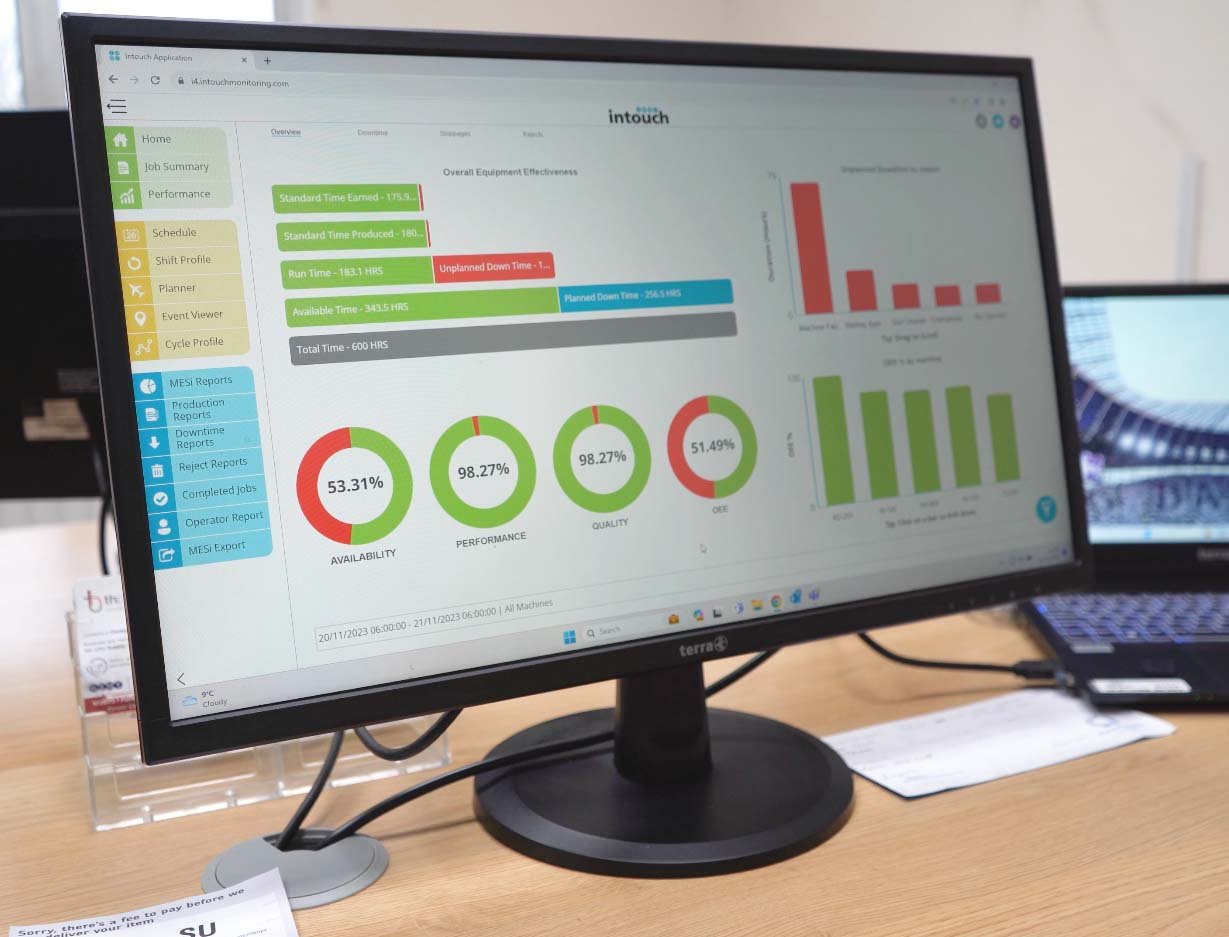
At Intouch, we help manufacturers gain complete visibility of their production operations through real-time machine monitoring, production scheduling and OEE reporting. Our easy-to-use Manufacturing Execution System (MES) gives production teams the insight they need to identify bottlenecks, reduce delays and keep production flowing.
If you’re looking for practical ways to remove manufacturing bottlenecks without increasing headcount or investing in new machinery, we’d love to show you how Intouch can help. Start your free 60-day trial today or speak to one of our manufacturing specialists to see how greater visibility can transform your operation.
3 Signs that you are ready to digitise your factory
Are you under pressure to improve efficiencies and reduce down time, which means you’re now looking to implement smart factory technology…
Plastics Manufacturing in a volatile world
The pandemic has highlighted that the need for flexibility and adaptability in manufacturing operations is crucial for navigating…
5 ways you could improve your production efficiency right now
The importance of production efficiency cannot be overstated. It means you are making the most out of your resources – time, materials,…

Have you thought about adopting smart technology?
What's stopping you adopting smart technology in your plant? Are you worried about the costs, the expertise and training needed? What is…
The advantages of a paperless manufacturing operation
So what happens when you switch to a paperless Manufacturing Execution System? You immediately get more predictable manufacturing with more…
Why is planned downtime for maintenance so important?
Often with pressure of delivery deadlines, it is easy for planned maintenance to be pushed down the priority list and only maintain it when…
How to choose the right manufacturing execution system (MES) for you
Selecting the right MES solution will give you the data and insights necessary to optimise your OEE, give you a competitive advantage and…
What would a 1%, 5% or 30% improvement in OEE mean to you?
Are you under pressure to improve efficiencies and reduce down time, which means you’re now looking to implement smart factory technology…

How to transform your plant’s efficiency and profitability with MES
Squeezing everything from your resources without compromising on quality is a challenge increasingly faced by manufacturers. So how can…
How it works
Getting started with Intouch is as easy as 1, 2, 3

1. Book a demo
Let us show you what we can do. Jump on a demo call and our friendly team will take you through the Intouch system and answer any questions you might have.

2. Enjoy a free trial
Don’t just take our word for it! We’ll lend you our technology for a 60-day free trial so you can see exactly how it can benefit the everyday operation of your business.

3. Receive ongoing support
It doesn’t end there. If you decide Intouch is the right production monitoring system for you, we’ll work with you to help you take control and make significant improvements in OEE.